- Use - this section will include how we followed the conventions in our short film
- Develop - this section will cover how we developed the conventions in our short film
- Challenge - this section will cover how we subverted the conventions in our short film
USE
In this section we will be looking at how we followed forms and conventions in Life of Hermit. We did this by analysing different topics in our short film including short film conventions, genre convention, representations of youth and gender and narrative theories.
Short Film Conventions
A short film refers to any film not considered a feature film in terms of length.
Length:
Being as they are 'short' films, the maximum running duration of a short film is 35 minutes. However, the typical duration of short films tend to be around 5 - 10 minutes including credits. As if short films were any longer than 35 minutes then they wouldn't be classed as a 'short', instead they would be considered as a feature film.
Storyline:
The storyline for short films are generally in the form of everyday situations. This makes them easy to watch and also allows the audience to relate to what they are watching, which keeps them intrigued. Being as they are limited in length, short films usually have minimal dialogue, which develops characters through images and actions rather than through long dialogue sequences.
Characters:
Due to the length limitation of short films and the simplicity of the storyline, shorts tend to only include 1 to 3 main characters. As they only have enough time to create background stories for these characters. Shorts purposely do this as it keeps the audience engaged without having to pay attention to new information, which would happen if there was too many characters. Shorts are usually long enough for the audience to create a connection with at least one character, as they don't have developed enough storylines to do this with more than three characters.
Morals:
Although short films don't have to include morals, it is common that they can be integrated into the storyline as a message for the audience at the end of the film. Moreover, if the short doesn't include a moral then they will usually have a specific emotion as the theme throughout the duration of the storyline. As these themes and morals will give the audience something to think about and maybe relate to throughout the film.
Plot Twist:
The majority of short films will include a plot twist, as this is a common short convention as they simply help make the film more interesting. Usually when the plot twist takes place the moral of the story will begin to be apparent to the audience if there is a moral included.
Budget:
The budget for short films are mainly rather low due to the fact that they are unlikely to make money. This effects the amount spent on making them, also the producers of short films are usually first time film makers, experimental artist and film makers with diminutive budgets. Short film producers will usually only have 1 or 2 locations and actors because of this reason as they don't have the budget to travel great distances and to pay large casts. However, actors may work for free in some circumstances depending on if the are friends of the producer or if they like the storyline or moral which the film is promoting.
Niche Audience:
It is a formality that short films will have smaller audiences compared to mainstream films due to the length, creativity and simplicity of the storyline. Shorts will appeal to specific audience depending on the genre and style of the film. Additionally, a significant amount of the population are not aware of short films despite their easy accessibility. The prime reason for this is due to them not being advertised compared to mainstream films as the producers can't afford an advertising campaign to their budget.
Credits:
All short films alike mainstream films will include credits. Stating the producer and the cast, shorts also include titles.
Genre Conventions
Before we can identify what genre conventions we have conformed
to, we firstly need to recognise what genre Life of Hermit is and by analysing
all of the themes used in our short film, we found out that Life of Hermit is a
psychological drama.
Psychological Drama is a cross-genre between drama and the
sub-genre, psychological. This means that the film include the same elements
from both of these genres. Life of Hermit is a psychological drama because it
involves a protagonist going through normal, everyday situations like a drama
however, it includes a psychical representation of the protagonist’s emotions
which is an element of a psychological film.
Here is a list of the main psychological drama conventions:
- Real life situations
- Personalities are realistic
- Issue with the protagonist’s sanity
- Themes about the mind
- Usually set in the present time
- Psychological films usually include a plot twist
We decided to conform to all of the psychological drama
conventions because we believe that our target audience will find it easier to
delve into the world of Hermit, as they are familiar with the themes and atmosphere
of the film.
Life of Hermit

Existing Films

1. We were inspired by the unusual atmosphere used in the psychological
drama film, Donnie Darko (2001), as throughout the film the main protagonist,
Donnie, is followed by someone dressed as a rabbit. From this, it created an unusual
atmosphere as we wouldn't know who is in the costume until the end of the film.
This inspired us to create the same atmosphere by having the psychical emotions
of Hermit wear masks that represent their emotions. We also used the same
non-linear narrative as Donnie Darko as in the film, events repeat themselves
until Donnie realises what he has to do. In Life of Hermit, the different scenarios
that the protagonist goes through are repeated in order for him to realise that
he is alone.
2. Throughout the film Black Swan (2010), the main protagonist, Nina Sayers, is psychologically consumed by her dark emotions and this eventually led to her downfall. We decided to follow the same events in Life of Hermit by having the angry emotion push Hermit against the lockers to show that the anger is consuming him.
4. Both of the main protagonists in The Way Way Back (2013) and Life of Hermit have the same personality and looks the same. In The Way Way Back, the main character, Duncan, has a very awkward personality and in some ways, he himself can be seen as a hermit. While this film leans more towards the drama genre, we liked how Duncan interacts with real life situations so we wanted Hermit to act the same way as he does with the events that he faces.
5. In Shutter Island (2010), the main character, Teddy, is seen to be a normal, US marshal throughout the film until a plot twist occurs that reveals Teddy to be a mental patient. In Life of Hermit, we also used the realisation scene as a plot twist because throughout the film, Hermit is seen as normal teenager until the reveal scene shows that he is actually by himself the whole time and lives as a hermit.
6. Throughout the events in American Beauty (1999), the main protagonist, Lester Burnham, goes through his normal life with these dream sequences that reveals his ideal scenario, such as being with an attractive woman other than his wife. The same idea is used in Life of Hermit as the protagonist would want to have friends so he dreams of these scenarios where he is with a group of people, socialising, however he is actually alone.
7. In the film, Misery (1990), the main protagonist, Paul Sheldon, is stuck in a cabin from a car accident. While the plot-line of Misery and Life of Hermit are completely different, the themes of loneliness are the same, as it used as a key plot point for both films. Paul Sheldon constantly reflects on his isolation while he is stuck in the cabin and Hermit goes through loneliness with each event that he is in.
8. In the film, Rebecca (1940), the main character, Mrs. de Winter, marries a widower and from that, she is constantly followed and taunted by the widower’s first wife as a ghost. We liked this idea that someone being followed by something psychological so we decided to use the same idea in Life of Hermit as the protagonist, Hermit, is constantly followed by his emotions.
9. We decided that we wanted to use the same style of film score as other psychological dramas, as we believe it will set the right tone of the story. For the opening scene of Life of Hermit, we were inspired to use the same style of music as American Beauty and Birdman (2014) because it creates a strange atmosphere that represents Hermit’s personality. For the locker, reveal and park scene, we were inspired to use the same styles of music as American Beauty, Donnie Darko and August: Osage County (2014) because we wanted to create an emotional impact to the audience so they understand how Hermit is feeling.
Here are the soundtracks that we were inspired by:
Life of Hermit: Opening Scene (0:00) influenced by...
Life of Hermit: Locker Scene, Reveal Scene and Park Scene (2:13 & 2:57) influenced by...
In summary to the genre conventions, it clearly shows that we have conformed to the conventions that a psychological drama includes. We have shown this by having the same themes and narrative techniques as existing psychological drama films, as well as being inspired by some of them.
Representation
Before we can look at how we followed the stereotypical representations of gender and youth, we firstly need to understand what they are.
Here is a list of the main hegemonic stereotype of gender in film:
- Females usually act like the damsel in distress
- Females tend to wear promiscuous clothing on occasion
- Females show almost no level of anger or violence
- The female characters tend to serve the male characters and mainly talk about them
- Males have a very masculine body
- The male characters usually respond with aggression or violence
- Males are always classed as the hero in compare to the female characters
- Males tend never show their emotional/feminine side to their personality.
Here is a list of the main stereotypes of youth in film:
- They are often seen as reckless and immature
- They tend to break the law such as under-age drinking
- They also hate other social groups apart from themselves
- They like to socialise a lot
Mise-en-scene
For some of the mise-en-scene included in our film, we decided that we would
use media forms and conventions. This can be an aspect that audience members
are used to seeing conform to the conventions, so we thought that as our film
may be difficult to understand, we decided that we would use and
conform to the colourology, props and costume throughout out film.
Camera Work & Editing
In order to fully realise how we have conformed to the representations of youth and gender, we have decided to analyse the film through the use of camera work and editing.
Here is a video to show how Life of Hermit follow the stereotypes of gender and youth:
Other represntations
In Life of Hermit, teenagers are the only social group who are represented as our film includes only 1 main character who is Hermit the protagonist. The actor playing hermit is 17 years old, the film only includes him and the physical form of his emotions who are the masked characters. Before Hermit realises that they are his emotions, they accompany him when he is at parties and the cinemas.


During the party scene, teenagers are portrayed negatively as we see Hermit alongside his emotions drinking alcoholic substances such as vodka.

This represents teenagers negatively as drinking under-age is against the law due to the obvious health risks.
Also when Hermit and his emotions are playing a game of spin the bottle, this also portrays teenagers negatively as this game reflects reckless and irresponsible behaviour because the game can be harmful. It is also a negative portrayal as by playing the game the teens are gambling in a sense as it could land on them. Gambling is also illegal if you are under the age of 18 as the characters in our film all are.
Gender:
Seeing as the protagonist of our film is Hermit, who as we have discovered is not the stereotypical manly male character. We have portrayed males in a rather mature light, as from the mise en scene that we have used and the clothes that we decided Hermit should wear I believe we have for filled this portrayal.


Females in our film are represented as being slightly promiscuous due to the clothes that they are wearing. For example, in the party scene the female characters are seeing wearing tight and short dresses.


These dresses show lots of their body off which is snared upon nowadays in society as they are seen to make females look cheap.
Theories
Throughout Life of Hermit, we have followed some narrative theories in order to create a familiar atmosphere to the audience while keeping the story original.
Here is a presentation that demonstrates all of the narrative theories that we have conformed to:

Develop
In this part of the question, we will have to show how we developed some of the conventional forms in our own media product.
Here is a video to explain how did this with Life of Hermit:
Challenge
In this section we will be looking at how we subverted forms and conventions in Life of Hermit. We did this by analysing different topics in our short film including short film conventions, camera work and representation of gender and youth.
Short Film Conventions
During
the beginning of the research of short films, we researched
different conventions of short films:
- Characters - Tend to stick to stick with 2 or 3 main characters, this is so the viewer can relate to the characters more.
- Twist - Shorts often contain a 'twist', this is to make the story line more interesting.
- Budget - Shorts have a low budget, they break their budget down by sticking to one or two locations and using few actors.
- Length - The maximum length for a short is 35 mins, but they are typically around 5-10 mins in length.
- Situation - The situation in a short is often everyday situations so more people can relate, but to make it more entertaining the situations are often turned on its head in some way.
- Narrative - linear and easy to understand
We
decided that as our film is unusual and is
the psychological drama, we would subvert
from some conventions of Short films to interest
the audience as it may be something they have never experienced
before.
Characters
- Short
films usually stick to 2 or 3 characters, allowing the audience
to connect emotionally with these characters so it becomes a more
enjoyable experience for the audience. But we decided we would challenge this
convention and have more than 2 or 3 characters, even when challenge this
convention the audience have emotionally connected with the character we want
them to because after the journey through the first half of the film making
them believe Hermit has many friends, in the second half we make them
realise how lonely this character actually is.
Narrative
- As
Short films aren't very long, there has to be a clear narrative throughout
the film and is generally is in linear narrative as it is easier for
audiences to understand. We decided we would challenge this convention and
have a non-linear narrative as it adds to the mystery of the film and explains
the film better than if it was in a linear narrative
Camera Work
Rule of thirds is a technique film-makers use. It is when you position the camera in a certain way that is proven
to be more comfortable for the eye to see, enabling the audience to watch
the main action in the shot without having to think about it.
Example of ROT being used in film:
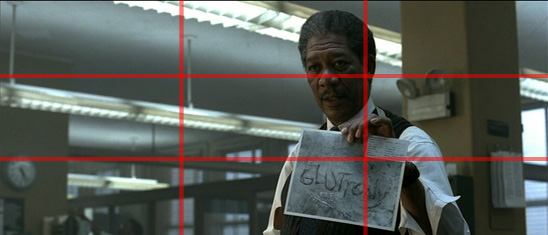
We decided that in our film we would
challenge the rules of camera work in film. We decided that in some shots in
our film we would subvert from the rule of thirds, and place the main
image in the centre of the screen. I will show the comparison with
our media product to existing media products using a key frame:
Life of Hermit:

Real media products:

1 - Close
up:
Life of Hermit: The
beginning of our film shows a close up of Hermit opening his eyes and looking
into the camera. We have decided that we would challenge the rule of thirds
and have Hermit directly in the middle. We decided this would interest the
audience straight away because it is unusual and may be something they
have not seen before.
Frank: Frank
is like our film in the use of Masks and has the same target audience, but
unlike our film this film has followed the rule of thirds and placed the
character on the right side of the grid.
2 - Cinema
Scene:
Life of Hermit: In
this scene Hermit is in the cinema on his own. We decided that we would subvert
from the rule of thirds in this scene as it shows the dead space around Hermit
to express to the audience his loneliness and emphasise the empty
seats around him.
Donnie Darko: Donnie
Darko is the same genre as our film, and is also a non-linear narrative and the
main character is somewhat like ours. But, in this scene they used the
rule of thirds during the cinema scene but it is still effective because you
can see the three characters but with the dead space and empty seats in
the background.
3 - Medium
Close Up/Seated:
Life of Hermit: This is
the scene when Hermit is reflecting on his life and accepting
his loneliness, so placing Hermit in the middle in this scene shows
the two empty places beside him, but him choosing to sit in the
middle represents that he is content with his loneliness and is
accepting it and choosing it and by using unusual shots, it is reflecting
his unusual personality.
The Breakfast Club: The Breakfast club is based on young teens with
different personalities and emotions like our film. This character
is unusual and lonely like Hermit, but this film has used the rule of
thirds.
4 -
Establishing House Shot:
Life of Hermit: This shot is showing the audience Hermits front door. By using
challenging the rule of thirds and leaving the door open after Hermit leaves
it, gives the audience an urge to want to know more about this character and
film because it is unusual.
Kill Bill: Like our
film, the main protagonist subverts from their stereotyped gender. In this
establishing shot we see the main protagonist entering the open
doored house, in this shot we see the whole house but the main focus is on
the protagonist who is walking in the rule of thirds and the main focus is
on her, however in Life of Hermit the main focus is on the door.
We thought this may be risky to challenge this film, but after looking into it there have been successful films that have also subverted from this rule:
We thought this may be risky to challenge this film, but after looking into it there have been successful films that have also subverted from this rule:

The Shinning (1980) has similar genres
such as physiological horror and mystery. Using shots like when the main
focus is in the middle of the image is something the eyes are not used to
when watching a film, which adds to the mystery and physiology of the film.
Firstly, the representation of gender with main protagonist, Hermit, subverts the conventions that are largely seen in films. Whilst the typical male character is seen to act masculine and heroic, Hermit doesn't show these traits as his personality is shown to be quite feminine because the human representation of his emotions are mainly female which would suggest that his state of mind is like a female. This clearly subverts the stereotype of male characters, as Hermit does not show any personality that is considered masculine or heroic. The colourology shown in Hermit’s room also supports this feminine trait, as his walls are pink, which is a stereotypical colour that is used with females therefore this subverts the representation of male.
 |
| The colour in Hermit's room is feminine. |
 |
| Males in films usually don't express their emotions. |
Another representation of gender that we have subverted is with the suffragette theory. This theory states that there is usually only one female in every group of people in live action films. We have subverted this as we included more females into the group then males which means that this has a female dominant cast. We decided to subvert this idea because we wanted to show that it doesn't matter if there are more females in the cast then there are with a male cast. Real production companies believe that the audience prefers a male dominant cast however we wanted to show that it is untrue.
 |
| Life of Hermit includes a dominant female cast. |
One more gender representation that we have subverted is that the female characters are a lot more stronger than the male characters. One of the conventions of female is that they tend to act like the damsel in distress and that they runaway from situations however, in Life of Hermit, some of the female characters do the complete opposite of this stereotype. One example of this is when the angry emotion, who is female, pushes Hermit into the lockers to threaten him and to show that she is much more stronger than him. Hermit reacts to this by walking away like the damsel in distress.
Youth
 |
| The angry emotion pushes Hermit against the lockers. |
We have decided not to subvert any representation of youth because we wanted to create a contrast between who Hermit is and the scenarios that he deals with in the film. We decided to create scenarios that is familiar with the audience so in order to do this, we had to conform to the representations of youth as those stereotypical scenarios would be familiar. These situations include, partying, school work and relationships. Once the film reveals the plot twist, it will highlight just how isolated he is in each scenario and from this, the target audience will be able to sympathise as they have been through the same situations but with friends.
